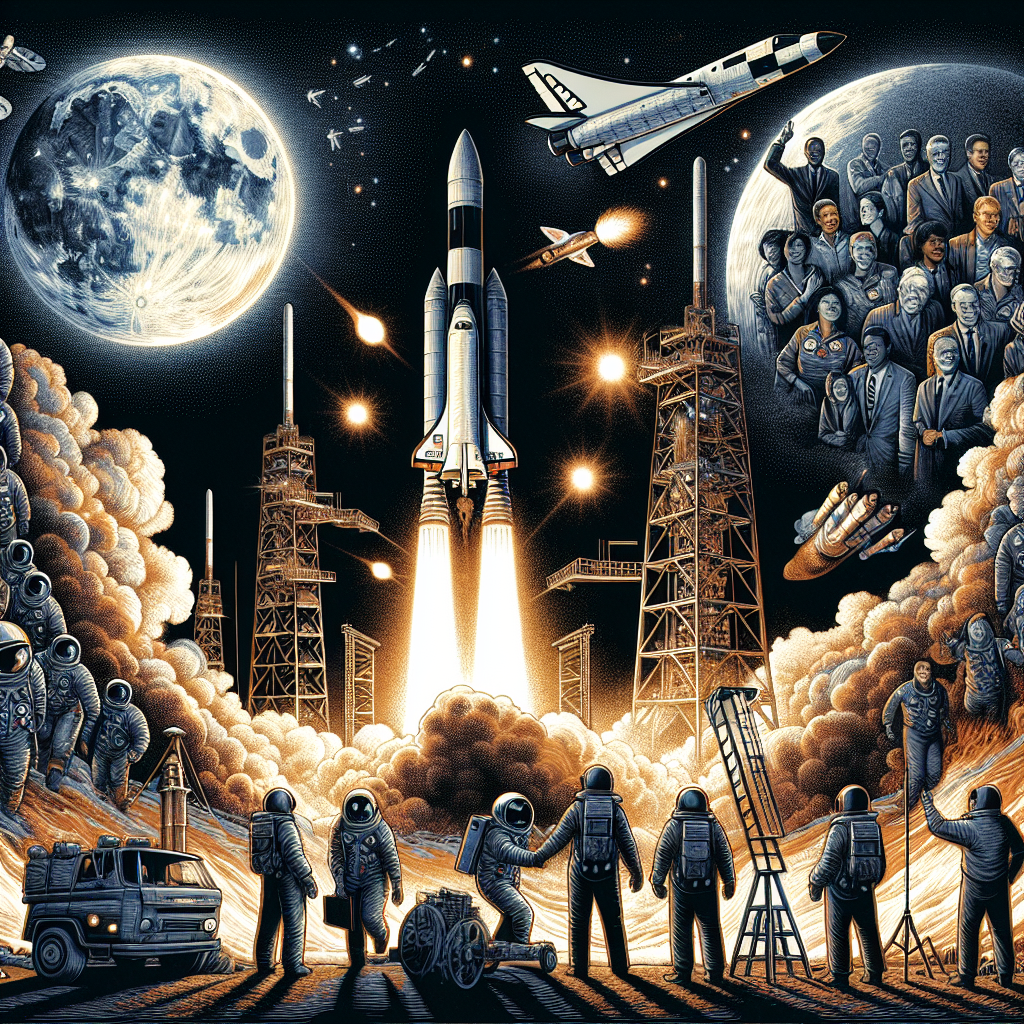
The Apollo Program stands as one of humanity’s most incredible technological and exploratory achievements. Conceived out of the Cold War rivalry, it has defined an era of space exploration marked by monumental challenges, triumphs, and ultimately, a legacy of inspiration for generations to come. This article will delve deep into the various facets of the Apollo Program, exploring its origins, milestones, challenges, and the lasting impact it has had on science and society.
Origins of the Apollo Program
The Apollo Program was initiated against the backdrop of the Space Race, a period during the Cold War characterized by intense competition between the United States and the Soviet Union. The Soviet Union had taken an early lead by launching the first artificial satellite, Sputnik, in 1957, followed by the first human, Yuri Gagarin, into space in 1961. These events ignited a sense of urgency within the U.S. government concerning space exploration and technological supremacy.
In 1961, President John F. Kennedy delivered a historic speech before Congress, boldly asserting that the United States would land a man on the Moon before the end of the decade. This was not merely a mission of exploration; it was a defining moment in American history, encapsulating hope, ambition, and the human spirit’s relentless pursuit of knowledge.
Project Goals and Objectives
The Apollo Program had an array of goals, including:
-
Landing a Human on the Moon: The primary objective was to land a manned spacecraft on the Moon and return safely to Earth.
-
Developing New Technologies: The program aimed to create technological innovations that could enhance both space travel and related fields.
-
Scientific Research: Apollo was not just about exploration; it also focused on gathering scientific data about the Moon and the Earth.
- International Prestige: Success in the Apollo missions was viewed as a means of demonstrating U.S. superiority during the Cold War.
Key Missions of the Apollo Program
The Apollo Program spanned from 1961 to 1972 and involved a total of 17 missions. While many missions focused on technology development, several stood out due to their significance.
Apollo 1
Originally designated AS-204, Apollo 1 tragically became a symbol of the challenges inherent in space exploration. On January 27, 1967, a cabin fire during a pre-launch test claimed the lives of astronauts Gus Grissom, Ed White, and Roger B. Chaffee. The incident led to a complete reassessment of safety protocols and engineering practices within NASA.
Apollo 7
Launched on October 11, 1968, Apollo 7 was the first successful crewed mission of the program. The mission was primarily a test of the command module in Earth’s orbit and lasted 11 days. The crew conducted several experiments which proved crucial for future missions.
Apollo 8
In December 1968, Apollo 8 marked a historic first: it was the first manned spacecraft to leave Earth’s orbit, reach the Moon, and return safely. The crew (Frank Borman, James Lovell, and William Anders) famously took the "Earthrise" photograph, which profoundly changed humanity’s perspective on its place in the universe.
Apollo 11
The crowning achievement of the Apollo Program occurred on July 20, 1969, when Apollo 11 successfully landed on the Moon. Astronauts Neil Armstrong and Buzz Aldrin descended to the lunar surface while Michael Collins remained in lunar orbit. Armstrong’s iconic words, “That’s one small step for [a] man, one giant leap for mankind,” resonated worldwide. The mission returned with 47.5 pounds of lunar rock and soil.
Apollo 13
Often described as a "successful failure," Apollo 13 launched on April 11, 1970. An oxygen tank explosion jeopardized the lives of the astronauts. However, thanks to remarkable ingenuity and teamwork, the crew was able to return safely to Earth on April 17. This mission highlighted real-time problem-solving capabilities and further cemented NASA’s reputation for resilience.
Apollo 15, 16, and 17
These missions focused on longer stays on the lunar surface and more scientific exploration. Apollo 15, launched in July 1971, used a lunar rover for the first time, enabling astronauts to travel further distances and collect more geological samples. Apollo 16 and Apollo 17 continued this trend, with Apollo 17 being the last mission of the program in December 1972. It set a record for the longest lunar surface stay at 75 hours.
Technological Innovations
The Apollo Program spurred developments that have had lasting impacts beyond space exploration. Some of the most notable technologies and innovations included:
-
Integrated Circuits: The need for compact, reliable computer systems in spacecraft led to the advancement of integrated circuits, pivotal in the electronics revolution.
-
Telemetry: Advanced telemetry systems were developed for data transmission between spacecraft and Earth, which laid foundations for modern telecommunications.
-
Materials Science: Innovative materials were designed for the harsh conditions of space, enhancing safety and performance not only in aerospace but also in commercial products.
- Life Support Systems: The program drove improvements in life-support systems, benefiting underwater exploration and creating applications in areas such as medicine.
Legacy of the Apollo Program
The Apollo Program represented an extraordinary period of human achievement. It fostered a sense of unity, inspiring individuals from diverse backgrounds to contribute to a common goal. The scientific knowledge gained from lunar missions significantly advanced our understanding of lunar geology, planetary formation, and the history of the solar system.
Moreover, the programs revitalized interest in STEM (Science, Technology, Engineering, and Mathematics) education, influencing countless future scientists, engineers, and explorers. The program’s spirit continues to fuel current and future endeavors, inspiring missions to Mars, asteroid mining, and the establishment of a sustainable presence on the Moon.
Cultural Impact
The Apollo missions permeated popular culture, influencing music, film, literature, and art. Songs like "Rocket Man" by Elton John and films like Stanley Kubrick’s "2001: A Space Odyssey" captured the imagination of millions, embedding the quest for space in the societal zeitgeist.
The powerful images and stories of astronauts walking on the Moon and looking back at Earth fostered a deeper awareness of the planet’s fragility. The shift in consciousness ushered in a new era of environmental awareness and global responsibility.
Challenges Faced
Despite its successes, the Apollo Program encountered numerous challenges, including:
-
Technical Difficulties: The complexity of designing reliable spacecraft with cutting-edge technology occasionally led to malfunctions and required rapid problem-solving.
-
Funding and Budget Constraints: As the initial excitement waned, budget cuts and political pressures at times threatened the program’s continuity.
-
Safety Concerns: The deadly Apollo 1 fire underscored the risks involved in crewed spaceflight, prompting significant changes to safety practices.
- Political Themes: The Cold War context influenced funding and priorities, at times overshadowing scientific interest in favor of geopolitical considerations.
FAQs about the Apollo Program
1. Why was the Apollo Program created?
The Apollo Program was created primarily to land humans on the Moon and return them safely to Earth, as part of the U.S. government’s effort to demonstrate technological and scientific superiority during the Cold War, particularly following the Soviet achievements in space.
2. How many missions were part of the Apollo Program?
The Apollo Program consisted of 17 missions, with 11 of them being crewed. Notable missions include Apollo 11, which successfully landed the first humans on the Moon; Apollo 13, which, despite a near-fatal incident, returned its crew safely; and Apollo 17, the last crewed mission to the Moon.
3. What were the Apollo lunar landers called?
The lunar landers used during the Apollo missions were called Lunar Modules (LM). The Lunar Module separated from the Command Module and descended to the Moon’s surface, allowing astronauts to explore.
4. What were some scientific contributions of the Apollo Program?
The Apollo Program returned over 800 pounds of lunar rock and soil which provided invaluable insights into the Moon’s geological history, comparative planetology, and the evolution of planetary bodies in the solar system.
5. What was the significance of the Apollo 8 mission?
Apollo 8 was significant as it was the first manned mission to orbit the Moon, which not only tested critical spacecraft capabilities but also provided breathtaking images of Earth from space, changing humanity’s perspective on its place in the universe.
6. How did the Apollo Program influence technology?
The Apollo Program led to numerous technological advancements, including developments in integrated circuits, materials science, and telecommunications. Many of these innovations found applications in various fields, including consumer electronics and medicine.
7. Have we returned to the Moon since Apollo 17?
As of now, no crewed mission has returned to the Moon since Apollo 17 in 1972. However, various space agencies, including NASA, have announced plans for future lunar missions through programs such as Artemis, aiming to establish a sustainable human presence on the Moon by 2024.
Conclusion
The Apollo Program was much more than a series of space missions—it was a monumental human endeavor that changed the landscape of scientific inquiry and technological advancement. The excitement and ambition captured during the Apollo era continue to inspire new generations of explorers and innovators. The spirit of that extraordinary pursuit encourages us to look to the stars, reminding us of what can be achieved when humanity unites in the quest for knowledge and understanding. The legacies of Apollo extend far beyond the Moon, igniting hope and possibility for the future of space exploration and inspiring us to dream bigger and reach further.
Leave a Reply